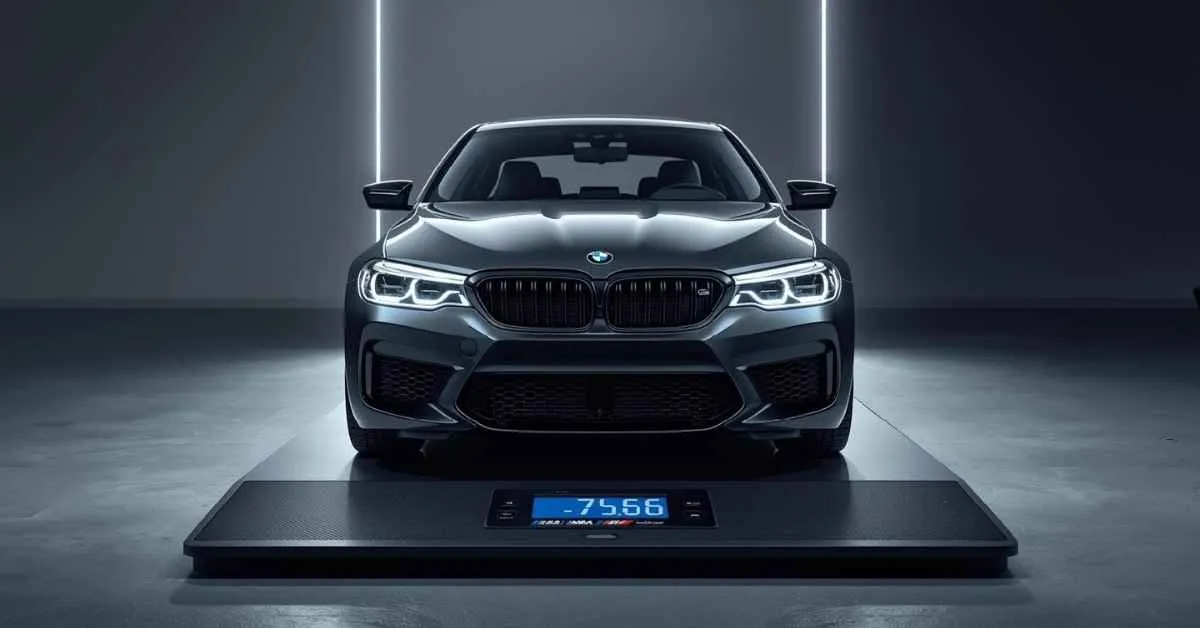
Let’s talk BMW M5 weight because yes, it’s a beast, but it’s a well-trained beast.
When people hear how much the M5 weighs, they expect it to be slow or clumsy, and that couldn’t be more wrong.
This car carries its weight like a pro athlete in a tailored suit. Power, luxury, tech, and comfort all add pounds, but they also add serious attitude.
If you’ve ever wondered how the BMW M5 balances mass with mind-blowing performance, you’re in the right place.
Let’s break it down without the boring car-nerd talk.
BMW M5 Weight by Generation
The BMW M5 has evolved significantly over the decades, with each generation introducing new technologies, engines, and luxury features that affect its weight. Understanding the curb weight of each model helps enthusiasts and potential buyers gauge performance, handling, and fuel efficiency.
- BMW M5 E28 (1985–1988) – The first-generation M5 was remarkably light, weighing around 1,350 kg (2,976 lbs). With a naturally aspirated inline-six engine and minimal electronics, it offered a pure driving experience.
- BMW M5 E34 (1989–1995) – Slightly heavier at 1,540 kg (3,395 lbs), this model added more comfort features and safety equipment while retaining excellent balance.
- BMW M5 E39 (1999–2003) – With a powerful V8, the E39 weighed approximately 1,640 kg (3,616 lbs). The use of aluminum in the chassis helped control weight while maintaining rigidity.
- BMW M5 E60 (2005–2010) – The V10 powerhouse increased the curb weight to around 1,700–1,730 kg (3,748–3,815 lbs). Advanced SMG transmission and luxury amenities contributed to this rise.
- BMW M5 F10 (2011–2016) – Introducing a twin-turbo V8, the F10 weighed 1,825–1,875 kg (4,024–4,132 lbs). Enhanced safety tech and luxury interior materials added to the mass.
- BMW M5 F90 (2018–2023) – With xDrive all-wheel drive, the F90 M5 weighs 1,925–1,980 kg (4,243–4,363 lbs). The Competition and CS models slightly reduce weight with carbon fiber components, but the overall heft reflects the car’s advanced systems and luxury features.
These figures show that while the BMW M5 has grown heavier, BMW balances this with improved performance, handling, and technology in every generation.
Why the BMW M5 Is So Heavy
Despite being a high-performance sedan, the BMW M5 carries significant weight, and understanding why helps explain its engineering brilliance. One major factor is luxury and comfort features. Modern M5s come with heated and ventilated seats, premium leather, advanced infotainment systems, and extensive sound insulation. All these amenities add hundreds of pounds, yet they contribute to the M5’s reputation as a sedan you can drive daily in comfort.
Another contributor is advanced safety technology. Features like adaptive cruise control, lane-keeping assist, multiple airbags, and reinforced structures increase the curb weight but ensure the M5 meets stringent global safety standards.
The all-wheel-drive system (xDrive), introduced in the F90 generation, also adds mass. AWD improves traction and stability, especially when unleashing the M5’s 600–625 horsepower, but it requires additional driveshafts, differentials, and heavier suspension components.
Performance hardware adds more weight too. High-performance brakes, adaptive suspension, and wider wheels ensure the M5 handles its power safely, but they increase the overall mass.
Even though weight may seem like a drawback, BMW engineers carefully distribute it across the chassis, maintaining near-perfect balance. This precise weight distribution allows the M5 to remain agile, accelerate impressively, and corner with confidence, proving that in this case, heaviness is a performance asset, not a liability.
Lightweight Materials Used in the BMW M5
While the BMW M5 is undeniably heavy, BMW has employed advanced lightweight materials to offset some of this mass and enhance performance. One of the most significant innovations is the use of carbon fiber reinforced plastic (CFRP). On modern M5 models, CFRP is found in the roof, mirror caps, rear spoilers, and even interior components in special trims like the M5 CS. A carbon fiber roof alone can save several kilograms, lowering the center of gravity and improving handling.
Aluminum is another key material. BMW uses aluminum extensively in suspension components, subframes, and engine parts to reduce unsprung weight, which directly improves agility and steering response. For example, aluminum suspension arms in the F90 M5 contribute to precise cornering while keeping durability high.
High-strength steel is strategically employed for safety-critical areas, such as the passenger cell, while keeping weight as low as possible. In combination with CFRP and aluminum, this creates a balance of rigidity, safety, and performance.
The BMW M5 CS takes lightweight engineering even further. With a stripped-down interior, reduced sound insulation, and more carbon fiber components, the CS model weighs around 80–100 kg less than the standard M5 Competition. These efforts show BMW’s dedication to ensuring that, despite its mass, the M5 delivers supercar-level performance while remaining a practical luxury sedan.
By carefully combining materials, BMW manages to counteract the weight of luxury and technology, keeping the M5 fast, responsive, and thrilling to drive.
How BMW M5 Weight Affects Performance
The weight of the BMW M5 plays a crucial role in its performance, influencing everything from acceleration to handling. While the M5 is heavier than many sports sedans, BMW engineers carefully balance its mass to maintain exceptional driving dynamics.
Acceleration is the first aspect affected by weight. Modern M5s, like the F90 Competition, weigh nearly 1,980 kg (4,363 lbs), but thanks to a powerful 600–625 hp twin-turbo V8 and all-wheel-drive traction, they achieve 0–60 mph times as low as 3.0 seconds. Here, the weight slightly reduces acceleration compared to lighter supercars, but traction and stability more than compensate.
Braking performance also reflects the M5’s mass. High-performance brakes, larger discs, and multi-piston calipers are engineered to safely stop a heavier sedan at high speeds. While a lighter car may stop marginally faster, the M5 maintains track-capable braking distances due to this balance of weight and hardware.
Handling and cornering are impacted by both overall weight and distribution. BMW places most of the M5’s weight low and centrally, aided by carbon fiber roofs and aluminum components, which lowers the center of gravity. This ensures the car remains agile in corners, minimizing body roll despite its heft.
Fuel economy is naturally influenced by weight. Heavier cars consume more fuel, but turbocharging helps maintain efficiency relative to performance. Overall, the BMW M5 demonstrates that with proper engineering, weight is not a limitation but a carefully managed factor that contributes to stability, comfort, and performance.
BMW M5 Weight vs Competitors
When considering the BMW M5, it’s helpful to compare its weight with other high-performance luxury sedans to understand its place in the market. While the M5 is heavier than some rivals, BMW balances this with superior handling, stability, and all-weather performance.
| Model | Curb Weight | Engine | 0–60 mph |
| BMW M5 F90 | 1,925–1,980 kg (4,243–4,363 lbs) | 4.4L Twin-Turbo V8 | 3.0 sec |
| Mercedes-AMG E63 S | 1,960 kg (4,321 lbs) | 4.0L Twin-Turbo V8 | 3.3 sec |
| Audi RS7 | 2,095 kg (4,619 lbs) | 4.0L Twin-Turbo V8 | 3.5 sec |
| Porsche Panamera Turbo | 2,090 kg (4,608 lbs) | 4.0L Twin-Turbo V8 | 3.6 sec |
As the table shows, the BMW M5 is slightly lighter than the Audi RS7 and Porsche Panamera Turbo but comparable to the AMG E63 S. This modest weight advantage, combined with BMW’s precise chassis tuning and xDrive AWD system, allows the M5 to accelerate faster off the line and maintain better balance through corners.
Even though rivals may offer more luxury space or interior technology, the M5’s weight distribution and performance-focused engineering give it an edge on both road and track. BMW has successfully managed to combine a heavy luxury sedan with sports car agility, making it one of the most well-rounded performance sedans in its class.
In short, while the M5 isn’t the lightest in its category, its weight is intelligently managed, maximizing traction, handling, and real-world performance.
Is the BMW M5 Too Heavy for Track Use?
Many enthusiasts wonder whether the BMW M5’s weight makes it less suitable for track driving. At first glance, with the F90 M5 tipping the scales at nearly 1,980 kg (4,363 lbs), it might seem cumbersome compared to lighter sports cars. However, BMW has engineered the M5 to excel on both road and track, despite its heft.
The all-wheel-drive xDrive system distributes power efficiently, providing exceptional traction out of corners and during hard acceleration. This system partially offsets the disadvantages of higher weight, allowing the M5 to maintain stability even under extreme driving conditions.
Handling is also optimized through careful weight distribution. With a low center of gravity, carbon fiber roof, and aluminum suspension components, the M5 corners with minimal body roll. Drivers can push it hard around turns without feeling like they’re piloting an overweight sedan.
Tire and brake wear are the main considerations for track enthusiasts. Heavier weight increases stress on tires and brakes, especially during extended track sessions. However, the M5’s high-performance braking system, adaptive suspension, and optional track-focused packages help mitigate these effects.
In real-world testing, the M5 is not “too heavy” for the track—it’s just a different experience compared to lightweight supercars. While it may not match a Porsche 911 in agility, it combines speed, stability, and safety in a package that allows drivers to enjoy track performance without sacrificing luxury or daily usability.
Real-World Driving Experience Despite the Weight
Despite its substantial curb weight, the BMW M5 remains exceptionally enjoyable in everyday driving. On highways, the M5’s weight contributes to stability, giving drivers a planted, confident feel at high speeds. This sense of composure is especially noticeable during lane changes, cornering, or when cruising on uneven road surfaces, where a lighter car might feel twitchy.
In city driving, the M5’s mass is less of a limitation than many might expect. Modern steering and adaptive suspension systems ensure responsive handling, while the M5’s balanced weight distribution keeps it agile through traffic and tight corners. The power delivery is smooth yet potent, allowing effortless acceleration even from low speeds, making stop-and-go traffic less taxing.
Comfort is another area where the M5’s weight actually helps. Heavier sedans naturally absorb road imperfections better, and combined with BMW’s adaptive dampers and precision-engineered suspension, the M5 glides over bumps and potholes with minimal disruption. Passengers benefit from a quiet, luxurious cabin, largely thanks to sound insulation that contributes to the overall weight.
Even for spirited driving, the M5 performs admirably. While it may not feel as lightweight as a pure sports car, its heft enhances traction, braking stability, and ride quality, allowing drivers to enjoy both performance and comfort simultaneously. In essence, the M5’s weight is an advantage rather than a drawback, offering a practical, high-performance driving experience that few competitors can match.
Can You Reduce BMW M5 Weight?
For enthusiasts seeking an even more performance-focused BMW M5, reducing weight is a common consideration. While the M5 is engineered to balance luxury and power, there are several ways to shed extra kilograms and improve acceleration, handling, and braking.
One popular method is aftermarket carbon fiber parts. Replacing the stock roof, hood, trunk lid, or mirror caps with lightweight carbon fiber components can save tens of kilograms, lowering the center of gravity and improving cornering stability. Even interior panels, such as seatbacks or trim pieces, can be swapped for carbon fiber alternatives in track-focused builds.
Lightweight wheels are another effective upgrade. Reducing unsprung mass improves suspension response, agility, and steering feel, allowing the M5 to react more quickly in corners. Some enthusiasts also upgrade to lightweight exhaust systems, which not only reduce weight but can improve airflow and enhance engine sound.
It’s important to weigh the pros and cons. Removing weight can reduce comfort or compromise some of the M5’s luxury features, such as sound insulation, infotainment, or heated seating. Additionally, aftermarket modifications may affect resale value or warranty coverage.
Despite these trade-offs, even modest weight reduction can make the M5 feel more agile on the track without sacrificing its luxury daily-driving capabilities. For those seeking the ultimate track-ready BMW M5, careful selection of lightweight upgrades allows drivers to maximize performance while preserving the car’s inherent balance and handling characteristics.
BMW M5 Weight FAQs
If you’re researching the BMW M5 weight, you probably have several common questions. Here’s a detailed FAQ section to clarify everything about the M5’s mass and its impact on performance.
1. How much does a BMW M5 weigh?
Depending on the generation, the BMW M5 weighs between 1,350 kg (E28) and 1,980 kg (F90 CS). Modern M5s are heavier due to added luxury features, safety systems, and all-wheel-drive technology.
2. Which BMW M5 is the lightest?
The E28 and E34 M5s were the lightest, thanks to minimal electronics and simpler construction. Among modern models, the F90 M5 CS is the lightest, shedding 80–100 kg compared to the standard Competition model through the use of carbon fiber, reduced sound insulation, and lighter interior components.
3. Does the M5’s weight affect performance?
While higher weight slightly impacts acceleration and fuel economy, BMW compensates with powerful engines, advanced suspension, and precise weight distribution. The result is a sedan that accelerates quickly, handles sharply, and remains stable at high speeds.
4. Why is the M5 heavier than the M3?
The M5 is a larger, more luxurious sedan with additional technology, safety equipment, and all-wheel drive. In contrast, the M3 is smaller, lighter, and more focused on track performance rather than full-size luxury.
5. Can the M5 feel too heavy for daily driving?
Not at all. Despite its mass, the M5 remains agile, smooth, and responsive thanks to careful engineering, adaptive suspension, and precise weight distribution, making it practical for both city and highway driving.
These FAQs provide clarity for buyers and enthusiasts, helping them understand that BMW M5 weight is carefully managed rather than a limitation.
Final Verdict Does BMW M5 Weight Really Matter?
After examining every aspect of the BMW M5’s weight, it’s clear that while the car is heavier than many sports sedans, this does not diminish its performance or appeal. The M5’s weight is a byproduct of luxury features, safety systems, advanced drivetrain technology, and high-performance components, all of which contribute to its unique combination of speed, comfort, and stability.
Modern M5 models, such as the F90 Competition and CS, demonstrate that weight can be intelligently managed. BMW employs carbon fiber, aluminum, and high-strength steel to lower the center of gravity, improve handling, and maintain structural rigidity. These engineering choices allow the M5 to feel agile and responsive, despite tipping nearly 2,000 kg in its heaviest forms.
On the road, the M5’s weight actually enhances stability, ride comfort, and traction, making it a practical luxury performance sedan. On the track, careful suspension tuning, weight distribution, and powerful brakes allow the M5 to compete with lighter rivals, proving that mass is not a limitation but a factor that BMW has mastered.
In comparison to competitors like the Mercedes-AMG E63, Audi RS7, and Porsche Panamera Turbo, the M5 balances its heft with superior chassis dynamics and AWD traction.
In conclusion, BMW M5 weight is not a drawback—it is a key component of what makes the car exceptional. Buyers get a sedan that can perform like a sports car, offer luxury like a premium sedan, and remain usable every day. For enthusiasts and luxury car lovers alike, the M5 proves that heaviness, when engineered properly, is a strength, not a weakness.