Why You’re Searching for “Rainbow” in Other Languages
If you’ve landed on this page, chances are you’re curious about how to say “rainbow” in different languages—whether for travel, education, creative writing, cultural exploration, or simply because you love the beauty of languages and the natural world. 🌍🌦️
A rainbow is not just a colorful arc in the sky—it’s a universal symbol of hope, diversity, peace, and promise. But how do people around the world refer to this magical phenomenon? That’s exactly what we’ll explore here.
By the end of this article, you’ll be able to:
- Learn the word “rainbow” in many major languages
- Understand how it’s used in real-world phrases
- Use the term confidently in conversation, writing, or translation
Let’s color your vocabulary with rainbows from around the world!
What Does “Rainbow” Mean?
A rainbow is a meteorological phenomenon caused by reflection, refraction, and dispersion of light in water droplets. It appears as a multicolored arc in the sky, typically after rainfall.
But beyond the science, “rainbow” is also a powerful metaphor. It often symbolizes:
- Hope and peace after a storm 🌤️
- Diversity and inclusion 🌈
- Magic, wonder, and joy ✨
Understanding this deeper meaning makes it all the more exciting to know how to say it in various languages.
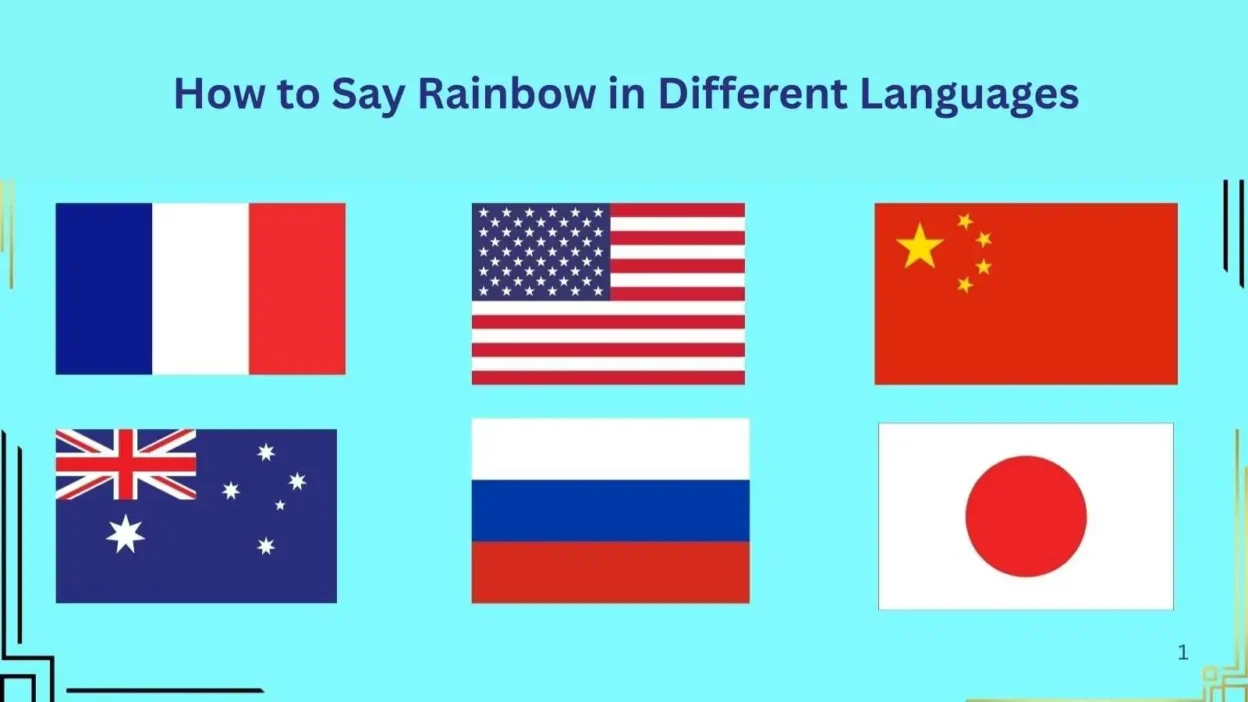
How to Say “Rainbow” in 50 Different Languages
Here is a list of how “rainbow” is said in different languages across continents:
| Language | Word for Rainbow | Pronunciation (Approx.) |
| English | Rainbow | RAYN-boh |
| Spanish | Arcoíris | AHR-koh-EE-rees |
| French | Arc-en-ciel | Ark-on-see-ELL |
| German | Regenbogen | RAY-ghen-boh-ghen |
| Italian | Arcobaleno | AHR-koh-bah-LAY-no |
| Portuguese | Arco-íris | AHR-koo-EE-rees |
| Russian | Радуга (Raduga) | RAH-doo-gah |
| Arabic | قوس قزح (Qaws Quzah) | Kaws Koo-zah |
| Chinese (Mandarin) | 彩虹 (Cǎihóng) | Tsai-hong |
| Japanese | 虹 (Niji) | NEE-jee |
| Korean | 무지개 (Mujigae) | Moo-jee-geh |
| Hindi | इंद्रधनुष (Indradhanush) | In-dra-dha-noosh |
| Urdu | قوس قزح | Qaws-e-quzah |
| Turkish | Gökkuşağı | GUHK-koo-sha-uh |
| Greek | Ουράνιο τόξο | Oo-RAH-nee-o TO-kso |
| Dutch | Regenboog | RAY-ghen-bohk |
| Polish | Tęcza | TEN-chah |
| Swedish | Regnbåge | RAYN-boh-geh |
| Finnish | Sateenkaari | SAH-ten-kah-ree |
| Hungarian | Szivárvány | SEE-vaar-vaan |
| Hebrew | קשת (Keshet) | KEH-shet |
| Persian (Farsi) | رنگینکمان | RANG-een kah-MAAN |
| Thai | รุ้ง (Rúng) | ROONG |
| Vietnamese | Cầu vồng | KOH vohng |
| Filipino | Bahaghari | Bah-hag-HAH-ree |
| Malay/Indonesian | Pelangi | Peh-LANG-ee |
| Swahili | Upinde wa mvua | Oo-PEEN-deh wah mm-VOO-ah |
| Zulu | Umnyama wemvula | OOM-nyah-ma wehm-voo-lah |
| Xhosa | Umnyama wemvula | OOM-nyah-ma wehm-voo-lah |
| Bengali | রামধনু (Ramdhonu) | RAHM-dho-noo |
| Tamil | வானவில் (Vānavil) | VAA-na-vil |
| Kannada | ಬಿಲ್ಲು (Billu) | BILL-loo |
| Punjabi | ਇੰਦਰਧਨੁਸ਼ (Indradhanush) | In-dra-dha-noosh |
| Nepali | इन्द्रेणी (Indreni) | In-DREH-nee |
| Sinhala | ඉර රැස (Ira Ræsa) | EE-rah RAY-sah |
| Latvian | Varavīksne | VAH-rah-veek-sneh |
| Lithuanian | Vaivorykštė | VAI-voh-reek-shteh |
| Czech | Duha | DOO-hah |
| Slovak | Dúha | DOO-hah |
| Romanian | Curcubeu | KUR-koo-bay-oo |
| Ukrainian | Веселка (Veselka) | VEH-sel-kah |
| Croatian | Duga | DOO-gah |
| Serbian | Дуга (Duga) | DOO-gah |
| Bulgarian | Дъга (Daga) | Duh-GAH |
| Icelandic | Regnbogi | RAYN-bo-gee |
| Irish | Tuar Ceatha | TOOR-kya-ha |
| Welsh | Enfys | EN-viss |
| Hawaiian | Ānuenue | AH-noo-eh-noo-eh |
| Maori | Āniwaniwa | AH-nee-wah-nee-wah |
How to Use the Word “Rainbow” in Sentences
Here are some ways you might use the word rainbow in different languages:
- Spanish: Vi un arcoíris después de la lluvia. (I saw a rainbow after the rain.)
- French: Un bel arc-en-ciel est apparu. (A beautiful rainbow appeared.)
- Hindi: बारिश के बाद इंद्रधनुष दिखा। (After the rain, a rainbow appeared.)
- Japanese: 雨の後に虹が見えました。 (I saw a rainbow after the rain.)
- Arabic: رأيت قوس قزح في السماء. (I saw a rainbow in the sky.)
By learning just a few of these, you can enrich conversations, travel with ease, or even impress your multilingual friends.
Why It’s Useful to Learn “Rainbow” in Many Languages
- ✅ For travelers: Helps when engaging with locals, especially children or nature lovers
- ✅ For teachers & students: Makes global classroom activities more fun and inclusive
- ✅ For writers & poets: Adds lyrical diversity to your descriptions
- ✅ For translators & linguists: Broadens your cultural and linguistic understanding
Conclusion
A rainbow may appear the same in every sky, but the way we describe it changes beautifully from place to place. By learning how to say “rainbow” in different languages, you’re not just expanding your vocabulary—you’re opening your mind to cultural wonder.
So the next time you see a rainbow, remember: someone in France calls it arc-en-ciel, someone in Japan says niji, and someone in Africa might say upinde wa mvua. But the feeling of awe is always the same. 🌦️🌍🌈