
If you’ve ever found yourself wondering how to say “sunny” in different languages, you’re not alone.
Maybe you want to describe a bright day while chatting with a friend from another country, add some warmth to your travel captions, or simply learn new words that bring joy.
Whatever your reason, this article will help you find exactly what you’re looking for — the translation of “sunny” in many languages, its meanings, and how to use it naturally in conversation.
By the end, you’ll not only know how to say sunny across the globe but also understand how this cheerful word connects cultures through the universal love of sunlight and positivity. ☀️
Why People Search for “Sunny in Different Languages”
People usually search for this phrase because they:
- Want to describe the weather or mood in another language.
- Need words for poems, songs, or captions related to brightness or happiness.
- Are learning a new language and wish to expand their vocabulary.
- Love exploring how one positive word—like “sunny”—can sound beautifully unique across cultures.
No matter the reason, learning this word in multiple languages helps express warmth, optimism, and brightness in every corner of the world.
Meaning of the Word “Sunny”

The word “sunny” mainly means:
- Bright with sunlight – e.g., “It’s a sunny day.”
- Cheerful or happy – e.g., “She has a sunny personality.”
So, depending on the context, “sunny” can describe weather or someone’s mood — and that dual meaning carries across many languages, often with cultural variations.
Translations of “Sunny” in Different Languages

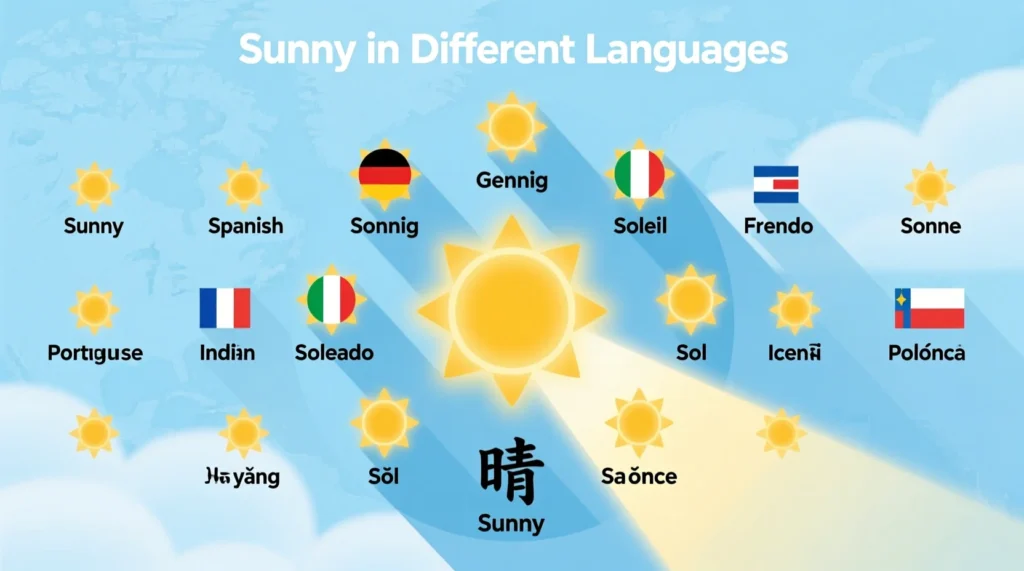
Here’s how you can say “sunny” around the world:
| Language | Translation | Pronunciation | Meaning / Usage |
|---|---|---|---|
| Spanish | Soleado | soh-leh-AH-doh | Used for weather; “El día está soleado.” |
| French | Ensoleillé | on-so-lay-YAY | Refers to bright or cheerful weather. |
| German | Sonnig | ZON-nig | Used for describing a sunny day. |
| Italian | Soleggiato | soh-lej-JAH-to | Commonly used for warm, sunny days. |
| Portuguese | Ensoporado / Ensolarado | en-so-lah-RAH-do | “Dia ensolarado” means “sunny day.” |
| Dutch | Zonnig | ZON-nikh | Used in phrases like “zonnig weer” (sunny weather). |
| Russian | Солнечный (Solnechnyy) | SOL-nyetch-nee | Can mean both “sunny” and “radiant.” |
| Arabic | مشمس (Mushmis) | MOOSH-mis | Commonly used in daily weather talk. |
| Hindi | धूप वाला (Dhoop Wala) | DHOOP wa-la | “Aaj dhup wala din hai” = “Today is a sunny day.” |
| Chinese (Mandarin) | 晴朗的 (Qínglǎng de) | ching-lahng duh | Describes clear, sunny skies. |
| Japanese | 晴れた (Hareta) | ha-re-ta | Used to express sunny or clear weather. |
| Korean | 맑은 (Malgeun) | mal-gun | Refers to clear or sunny conditions. |
| Turkish | Güneşli | goo-NEHSH-lee | “Güneşli gün” means “sunny day.” |
| Greek | Ηλιόλουστος (Ilioloustos) | ee-LEE-oh-loos-tos | Beautiful word meaning “bathed in sunlight.” |
| Swedish | Solig | SOO-lig | Describes sunny weather or mood. |
| Polish | Słoneczny | swo-NECH-ny | Also used for cheerful expressions. |
| Filipino (Tagalog) | Maaraw | ma-AH-raw | “Maaraw na araw” = “Sunny day.” |
| Indonesian | Cerah | che-RAH | Means clear, bright, or sunny. |
| Swahili | Jua kali | joo-ah kah-lee | Literally “strong sun,” used for sunny weather. |
How to Use “Sunny” Naturally in Conversation

Depending on what you want to express, you can use “sunny” in different ways:
1. To Describe Weather
- “It’s such a sunny day today!”
- French: “C’est une journée ensoleillée.”
- Spanish: “¡Es un día soleado!”
2. To Describe Someone’s Personality
- “She has a sunny smile.”
- German: “Sie hat ein sonniges Lächeln.”
- Hindi: “Uski dhup jaisi muskurahat hai.” (Her smile is like sunshine.)
3. For Social Media Captions
If you’re posting travel photos or summer vibes, try:
- “Feeling sunny and blessed.”
- “Life is brighter under the sun ☀️.”
Or mix it with translations for a global touch: - “Vibes soleadas 🌞” (Spanish)
- “Mood ensoleillé 🌤️” (French)
Cultural Connection of the Word “Sunny”

Across the world, “sunny” isn’t just about the weather — it symbolizes hope, joy, and energy.
In some cultures:
- In Japan, sunny weather is linked to optimism and new beginnings.
- In Arabic-speaking regions, a “mushmis” day represents blessings and productivity.
- In Western countries, “sunny” often appears in songs, poems, and nicknames to express positivity (like “Sunny” by Boney M 🎵).
The word bridges cultures with its warm, uplifting energy — a reminder that light and happiness are universal.
Conclusion
Learning how to say “sunny” in different languages isn’t just about translation — it’s about sharing a positive feeling that transcends borders. Whether you’re writing, traveling, or simply appreciating the weather, knowing these variations helps you connect with people globally in a cheerful and authentic way.


